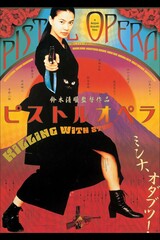
I think it's okay to live my life as a pistol.
The compression of violent power fantasy, sexual pleasure and monetary gain into a singular driving force. The pistol is a boyfriend, a dildo, a tool of control, has an abstracted capital value and finally the person themselves becomes a pistol – fully subsumed by the sociocultural shift of capitalism.
With Pistol Opera Suzuki takes his Taisho era mythic experimentation and applies it to the themes of his much earlier crime films. Here too is the new mythic language of the early 00’s: that of the comic book, the advertisement and the music video. Alongside it, the new mythological concerns of life under capitalism and the uneasy relationship between Japan and the West.
i love when you can really see an author's signature on their work (boom mic in frame)
“I didn’t mean to kill each other, really!”
Godard speculated that cops were the heroes of so many films because of their freedom, the mobility their power grants them. I think it’s something similar with movie assassins, but even more romanticized. Cops are still extracted from reality; while assassins certainly exist, the movie assassin presents an obvious fantasy. As Suzuki said:
They wander between life and death. As a character they are more interesting than normal people. They live very near death, so we can describe how they die, where they die, and when they die. You have a wider range of possibilities than you otherwise would if you were depicting a normal person.
Branded to Kill’s Goro and Pistol Opera’s Stray Cat aren’t necessarily tormented by the sin of their profession. Individual guilt and attempted redemption isn’t the prize, sidestepping the genre’s usual moralism. Subtracting the real world, this network of assassins is a universalization of structural power games - the Byzantine surreality of bureaucratic position jostling.
The game itself is more intriguing for Suzuki. To borrow a cheap old metaphor, a game seen through fun house mirrors, stretching into distorted infinities. Branded to Kill was total abstraction, pure music; in Pistol Opera, something suppressed steadily rises as the film progresses, “Left to right,” deeper into a tonal frenzy. The negated blood has a subterranean energy that refuses silence.
Like the Taisho trilogy, the uneasy meeting of Japan and the West is key here, interrupting fitfully until finally exploding into a storm of allusions. The players are beached on the 21st century, a new continent of ideological and cultural detritus. They seem only to kill each other in a closed, absurdist loop, lost in a game played for want of actual truth. No one is as certain of its hollowness as they, but the motions continue, the ball keeps rolling. It’s a matter of momentum: they must kill, they must jostle, or vanish outright as a purposeless system of ciphers.